Best Facilities Maintenance Software for Retail (2026) - 6 Platforms Compared | Operio
This guide compares six facilities maintenance software platforms for retail in 2026, starting with the one purpose-built for multi-location retail operations.
What Is Facility Management Software for Retail?
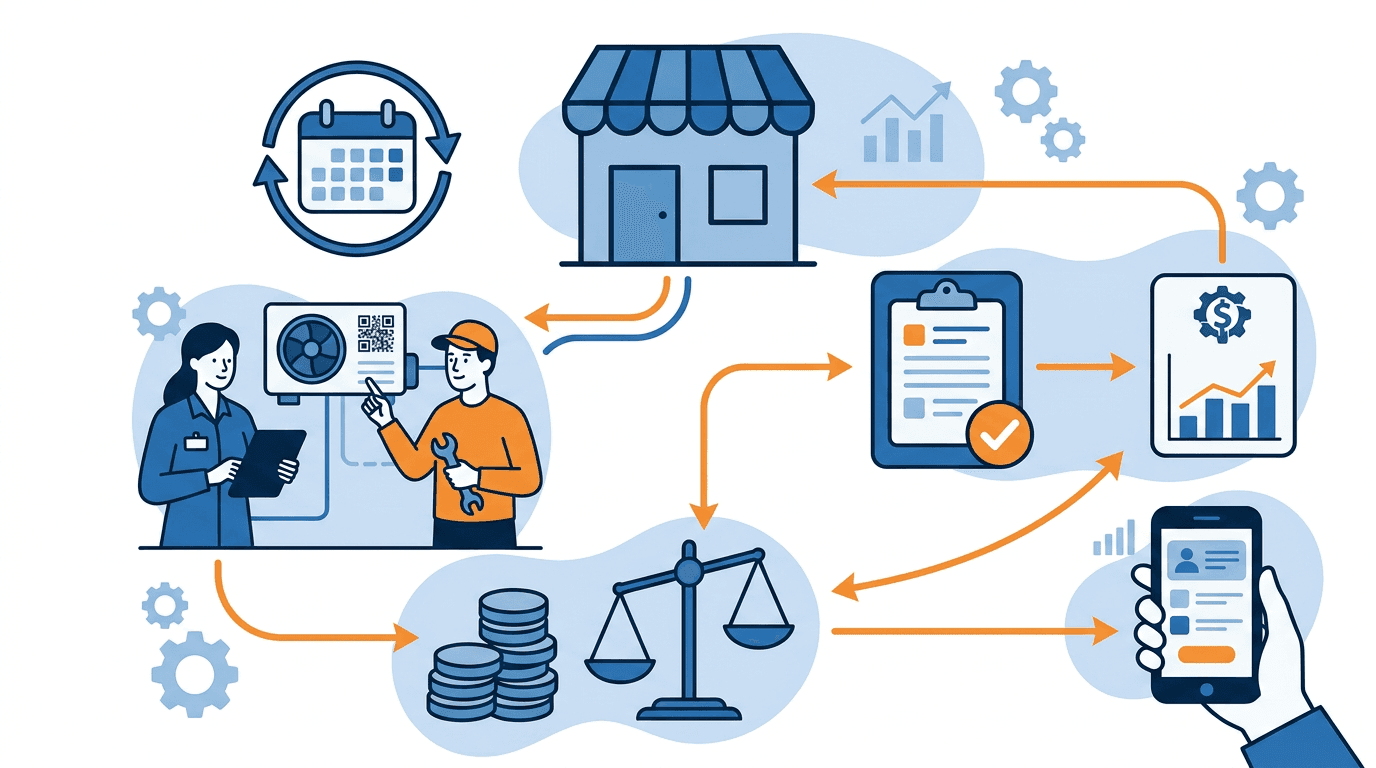
Facility management software for retail is a platform that centralizes the maintenance, asset tracking, vendor coordination, and cost control of physical store environments across multiple locations. It replaces fragmented tools (spreadsheets, phone calls, messaging apps) with a single system that gives both store-level teams and regional operations managers visibility into every open maintenance request, scheduled service, and maintenance cost.
Core capabilities in a retail FM platform:
Work order management: store managers submit requests, HQ reviews and assigns, vendors execute and close
Preventive maintenance scheduling: automated recurring tasks for HVAC, lighting, refrigeration, and other store equipment
Vendor and contractor management: assign work orders to external service providers, track SLA compliance, compare performance across locations
Asset tracking: QR-based equipment records connected to service history and maintenance schedules
Budget and cost control: location-level spend visibility with approval workflows before costs are committed
Mobile access: store staff submit requests and technicians close work orders from their phones
What Makes Retail FM Different from General Facility Management?
Most facility management software is built for single-site environments: a manufacturing plant, a hospital, a corporate campus. Retail operations have a fundamentally different structure.
Distributed locations, lean central team. A retail operations director managing 50 stores cannot have eyes on every location. The software has to provide that visibility automatically, not on request.
Non-technical requesters. Store managers are not maintenance professionals. The request submission experience needs to work for someone who has never used a CMMS and is standing in front of a broken piece of equipment with a line of customers waiting.
External vendor dependency. Most retail maintenance is handled by external contractors, not in-house technicians. Vendor coordination, SLA tracking, and invoice management are core requirements, not optional features.
Brand consistency. A broken air conditioner in one store affects how customers perceive the entire brand. Maintenance standards need to be enforced consistently across all locations, not left to individual store managers.
Cost visibility across a network. Operations finance teams need to see maintenance spend by location, by asset category, and by vendor, not just a total figure at year-end.
Top 6 Facilities Maintenance Software Platforms for Retail
1. Operio: Best Facility Management Software for Retail Chains
Operio is a CMMS and facility management platform built specifically for multi-location retail businesses. It covers the complete retail FM workflow: store-level request submission, HQ triage and approval, vendor assignment and SLA tracking, asset management, and location-level budget control in a single platform.
Key features:
Store-to-HQ work order flow: store managers submit requests via mobile, regional teams approve and assign, vendors execute and close with photo documentation
QR-based asset management: scan any piece of store equipment to access its full service history, open a work order, or log a completed task
Automated preventive maintenance scheduling with alerts before service dates pass
Vendor directory with performance tracking, SLA monitoring, and cross-location cost comparison
Location-level budget management with real-time spend tracking and approval workflows
Mobile-first interface designed for non-technical store staff
Cross-location dashboard for regional managers and operations directors
Full Turkish-language platform and support
Pricing: Free tier with 25 work order credits, no credit card required. Premium from $20/user/month or $16/user/month billed annually. Enterprise pricing for teams of 50 and above. First year free for new customers.
Best fit: Retail chains, restaurant franchises, hotel groups, bank branch networks, and healthcare facility networks managing maintenance across multiple locations.
Request a free demo at operio.co
2. ServiceChannel: Best for Enterprise Retail Networks at Scale
ServiceChannel is the dominant facility management platform for large enterprise retail chains. It processes billions in annual maintenance spend through a contractor marketplace of over 60,000 pre-vetted trade partners.
Key features:
Contractor marketplace with pre-qualified vendors by trade and region
AI-powered work order routing and service automation
Real-time analytics on facility spend, contractor performance, and asset lifecycle
POS and ERP system integrations
Compliance management and regulatory reporting
Pricing: Custom enterprise pricing. Typically suited to organizations with 500+ locations and dedicated FM departments.
Best fit: National and multinational retail chains with large in-house FM teams and the operational complexity to justify enterprise implementation.
Worth noting: Pricing and implementation complexity make it unsuitable for mid-market retail operators (10-200 locations) without dedicated facility management departments.
3. MaintainX: Best for Mobile-First Maintenance Teams
MaintainX is a mobile-first CMMS with strong adoption among field maintenance teams. Its clean interface and built-in team messaging make it a popular choice for organizations moving off paper and spreadsheet-based workflows.
Key features:
Real-time work order tracking with team messaging built in
Preventive maintenance scheduling by time or meter
Procedure templates and checklists for standardized maintenance tasks
Parts and inventory management
Integrations with Slack, Microsoft Teams, and ERP systems
Pricing: Free plan available. Essential at $16/user/month, Premium at $49/user/month.
Best fit: Small to mid-sized maintenance teams prioritizing fast adoption and mobile execution.
Worth noting: Built primarily for in-house maintenance teams rather than vendor-heavy retail operations. Multi-location dashboards and vendor SLA tracking are less developed than dedicated retail FM platforms.
4. Limble CMMS: Best for Budget-Conscious Multi-Location Teams
Limble CMMS combines ease of use with solid multi-location support, making it a popular choice for operations teams moving from spreadsheets to structured maintenance management.
Key features:
Multi-location work order management with customizable dashboards
Automated preventive maintenance triggers
QR-based asset tracking with equipment history
Vendor and contractor management
Cost reporting by location and asset type
Pricing: From $28/user/month. Professional at $69/user/month.
Best fit: Mid-sized operations teams in manufacturing, food service, and facilities management that need a cost-effective CMMS with multi-location support.
Worth noting: No Turkish language support. Designed primarily for manufacturing and industrial environments; retail-specific workflows (store-to-HQ request flows, brand standard enforcement) are not the primary focus.
5. UpKeep: Best for Asset-Heavy Retail Operations
UpKeep is a mobile-first asset operations platform with strong equipment tracking capabilities. Its IoT sensor integration enables automated work order creation based on equipment condition.
Key features:
Mobile-first work order creation and asset lookup
IoT integration for condition-based maintenance triggers
Equipment performance tracking with downtime analysis
Parts inventory connected to asset records
API integrations with major ERP and POS systems
Pricing: From $20/user/month (Starter). Business+ at $50/user/month.
Best fit: Retail operations with significant equipment assets (refrigeration, HVAC, kitchen equipment) where condition monitoring and asset performance data are priorities.
Worth noting: Strong on equipment tracking and mobile execution; less specialized for vendor coordination and store-to-HQ request workflows that define retail FM operations.
6. Snapfix: Best for Simple Retail Store Maintenance
Snapfix takes a photo-first approach to maintenance management, designed for simplicity. Store staff photograph issues to create work orders, which managers then route and track through a color-coded status system.
Key features:
Photo-based issue reporting from any mobile device
Planned tasks and preventive maintenance scheduling
Simple manager dashboard for task oversight
Hotel and retail PMS integrations
Team communication built into task workflows
Pricing: From €9/user/month.
Best fit: Small retail operations or individual store locations looking for a simple, low-cost entry into digital maintenance management.
Worth noting: Limited asset management depth and no vendor SLA tracking. Not designed for multi-location operations that need cross-location reporting, budget management, or structured vendor coordination.
Retail Facility Management (FM) Softwares Comparison Table
Platform | Starting Price | Multi-Location Dashboard | Vendor SLA Tracking | QR Asset Management | Budget Control | Turkish Language |
|---|---|---|---|---|---|---|
Operio | Free | ✓ | ✓ | ✓ | ✓ | ✓ |
ServiceChannel | Custom enterprise | ✓ | ✓ | ✓ | ✓ | ✗ |
MaintainX | $16/user/mo | ✓ | Limited | ✓ | Limited | ✗ |
Limble CMMS | $28/user/mo | ✓ | ✓ | ✓ | ✓ | ✗ |
UpKeep | $20/user/mo | ✓ | Limited | ✓ | Limited | ✗ |
Snapfix | €9/user/mo | Limited | ✗ | ✗ | ✗ | ✗ |
How to Choose Retail Facility Management Software
Start with your location count and team structure. For enterprise retail chains (500+ locations) with dedicated FM departments, ServiceChannel's contractor marketplace and enterprise analytics justify the investment. For mid-market retail (10-200 locations) with lean operations teams, the right platform is one that works without dedicated FM expertise.
Evaluate the request submission experience for store staff. If submitting a maintenance request requires training, store managers will not use it. The best retail FM platforms make request submission as simple as taking a photo and selecting a category.
Check vendor management depth. Most retail maintenance is handled by external contractors. If the platform cannot assign work orders to vendors, track their response times, and measure SLA compliance automatically, you will still be managing vendor performance manually.
Verify cross-location reporting. Can a regional manager see every open work order, every overdue asset inspection, and every location's maintenance spend from a single screen? If not, the platform will require manual data consolidation for every ops review.
Confirm budget control. Maintenance spend in a multi-location retail network requires location-level budget visibility and approval workflows before costs are committed. A platform that only shows costs after they have been invoiced does not give operations teams the control they need.
FAQ
What is facilities maintenance software and how is it different from a CMMS?
Facilities maintenance software is the broader category covering all tools used to manage the maintenance of physical environments: work orders, preventive maintenance scheduling, vendor coordination, asset tracking, and cost management. A CMMS (Computerized Maintenance Management System) is a specific type of facilities maintenance software focused on maintenance workflow management. In practice, the terms are used interchangeably, and most modern platforms cover both.
What is a facility management app and what should it do for retail store teams?
A facility management app is the mobile interface through which store staff, field technicians, and managers interact with the FM platform. For retail, the app needs to serve two very different users: store managers who are not maintenance professionals (simple photo-based request submission, real-time status updates) and field technicians or vendors who need full work order details, asset history, and the ability to log completion with photo documentation. The best retail FM apps work offline and do not require training to use.
What does facilities maintenance software cost for a retail chain?
Pricing varies significantly by platform and scale. Entry-level tools like Snapfix start from €9/user/month. Mid-market CMMS platforms like MaintainX, Limble, and UpKeep range from $16 to $69/user/month. Enterprise platforms like ServiceChannel are custom-priced, typically suited to organizations with 500+ locations and dedicated FM budgets. Operio offers a free tier with 25 work order credits and paid plans from $20/user/month, with the first year free for new customers.
How does facility management software handle vendor coordination for retail?
In a well-designed retail FM platform, vendor coordination is built into the work order workflow. When a work order is created, it can be assigned directly to a specific external contractor. The system tracks whether the vendor has acknowledged the assignment, monitors elapsed time against the agreed SLA, and records the outcome when the job is closed. Performance data accumulates automatically across work orders, so operations teams can compare vendor response times and completion rates across locations without any manual tracking.
What is the best facility management software for retail chains in Turkey?
Most facility management software is designed for English-speaking markets, with no localization for Turkish regulatory requirements, invoicing standards, or language preferences. Operio is the only platform in this comparison built specifically for the Turkish market, offering a full Turkish-language interface, local support, and workflows designed around how Turkish retail chains, hotel groups, and franchise operations actually manage their maintenance and facility operations.
How many locations does a retail business need before facility management software becomes necessary?
Most operations teams find that manual processes (spreadsheets, phone calls, WhatsApp groups) start breaking down at 3 to 5 locations. Beyond that threshold, the volume of maintenance requests, vendor interactions, and asset records exceeds what any team can manage accurately without a centralized system. With the right platform in place, the same team can manage 50 or more locations with consistent processes and full visibility across all sites.